|


Robert
Taylor, born in Ireland in 1787, as a child
immigrated with his family to Savannah, GA, in the 1790's.
Taylor grew up to become a wealthy cotton merchant and
planter, and his family would often spend summers at their
plantation in Morgan County. Around 1844, he built
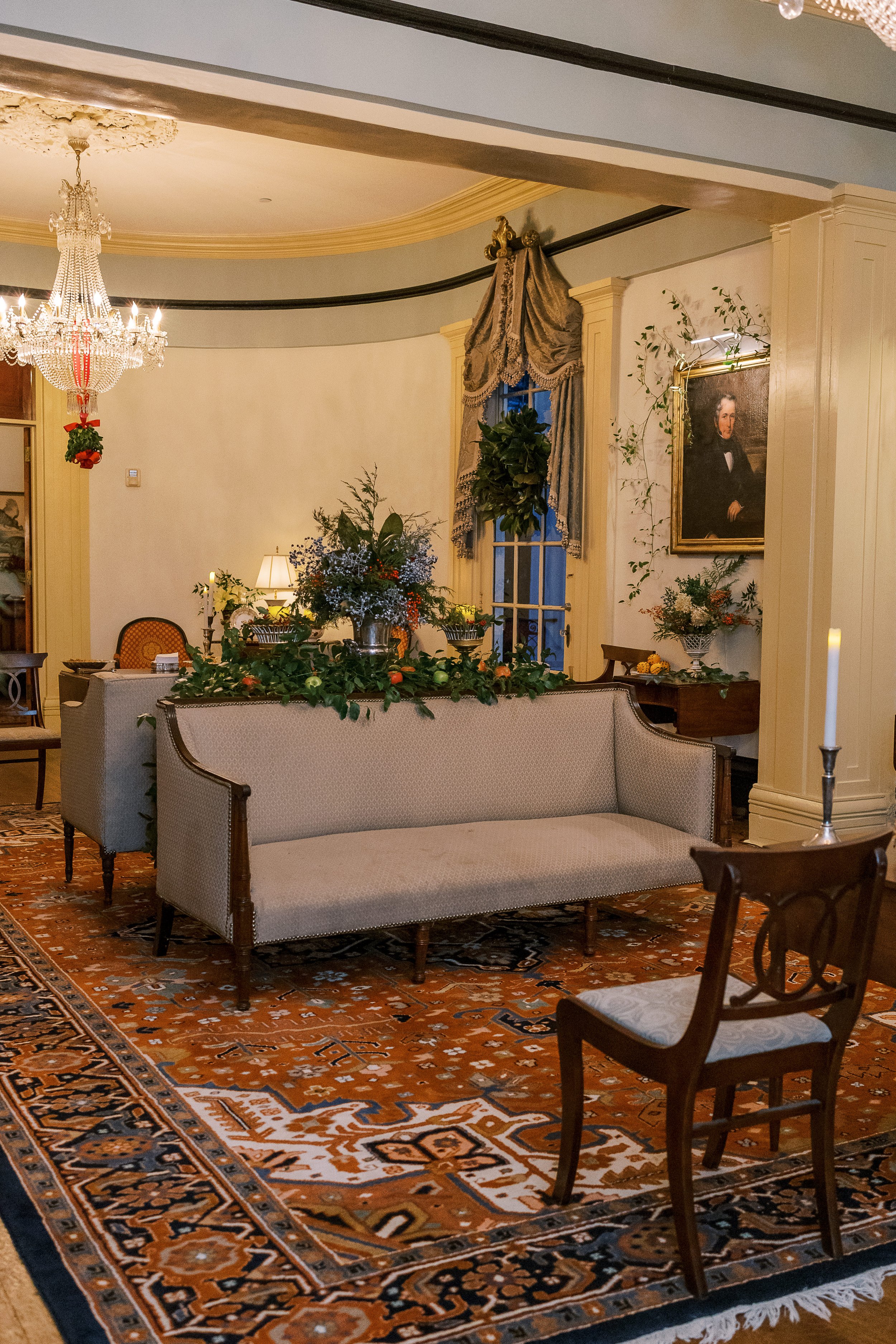
this Greek revival mansion as a summer home in Athens.
When his three sons entered the University of Georgia, the Taylors became permanent residents of Athens. Taylor
was commissioned a Brigadier General in the Georgia Militia,
and although he resigned his commission in 1845, he was
always addressed as "General" Taylor. He died in 1859,
the owner of over 17,000 acres throughout Georgia, and his
estate was valued at more than $450,000. |
|
Henry W.
Grady
was born in Athens in 1850. His
father, Major William S. Grady, bought this house from the
Taylor family in
1863 while on furlough from the Confederate Army.
Because renters were living in the house at the time, Major
Grady went back to the war without moving his family and was
later killed at the Battle of Petersburg in Virginia.
Henry Grady lived here
from 1865, while he attended the University of Georgia,
until 1868 when he graduated. He once referred to the
house as "an
old southern home, with its lofty pillars, and its white
pigeons fluttering down through the golden air."
Grady eventually became managing editor of the Atlanta
Constitution and was known as an impressive orator.
In December, 1886, he delivered his "New South" speech at
the New England Club in New York City, whose members
included prominent financial figures J. P. Morgan and
Charles Tiffany. He began his speech with a quote from
fellow Georgian, Benjamin H. Hill, "There was a South of
slavery and secession; that South is dead . . . a South of
union and freedom; that South, thank God, is living,
breathing, growing every hour," and his listeners responded
with wild applause. He became a national figure
overnight, stressing in his speeches and writings the need
for reconciliation and economic development. At the
age of 39, Henry Grady died of pneumonia in Atlanta. |
 |
|
After exchanging
hands many times, the house belonged to an
estate in the 1950s' and 60's and was left vacant for thirteen
years. The house fell into disrepair during that time
but was saved in 1966 when the city of Athens purchased the
house, and the Athens Junior Assembly (now called the Junior
League of Athens) coordinated its first restoration,
receiving many donations of goods and services from local
businesses and citizens. In 2004, the house closed
again for a year-long, $1.7 million renovation, funded by a
special local sales tax program. The purpose of this
renovation was to restore the house to historical accuracy
in regard to its period of significance, when it was home to
Henry Grady. Because it is Grady's only home that
still stands, the house was designated a National Historic
Landmark in 1976. The restoration of the house to
historical accuracy involved in-depth color studies on all
interior walls and landscaping changes to be reminiscent of
the wooded front yard the house once had. As the house
is now intended for public use, the bathrooms, closets, and
modern kitchen were left in place. Originally, the
house had no bathrooms or closets as they were considered
rooms that could be taxed. The renovation also
included many modern updates, such as a fire sprinkler
safety system, new electrical wiring, and a new climate
control system.
Today, the
Junior League of Athens keeps the house open to the public
for rentals and tours.
For more information or to
schedule a tour, please contact us by email at
jlathens@aol.com or
by phone at (706) 549-8688. |
|